Practice Schedule
Jun 8, 2026
Put the Guitar Where You Live
Three small structural changes — where the guitar lives, what you'll practice next, and how you handle the first few minutes — do more for daily practice than any amount of trying harder.
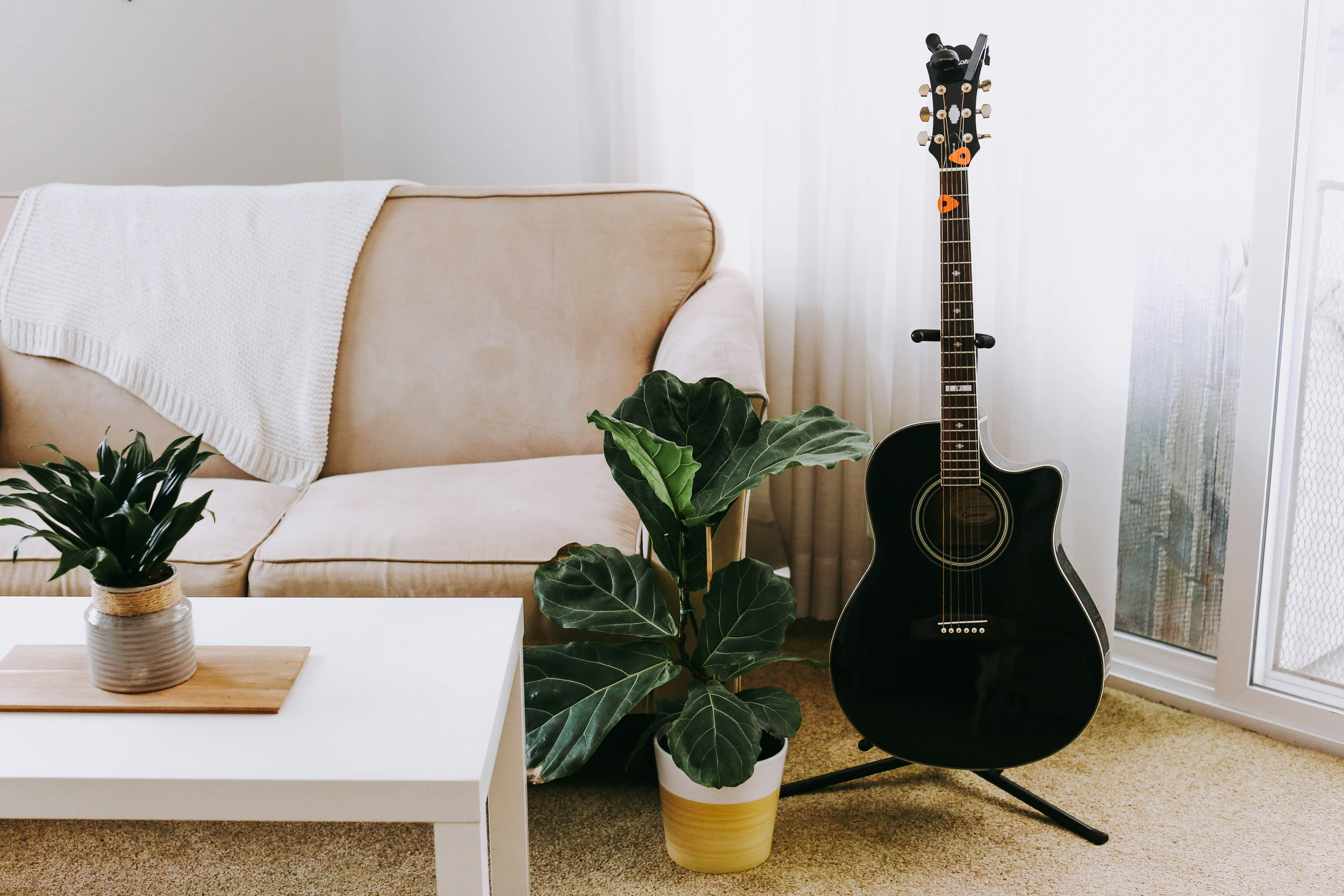
The biggest barrier to practicing every day isn't discipline. It's distance — the number of small steps between you and the guitar.
Key Takeaways
Visibility drives use. A guitar on a stand in your living space gets picked up far more often than one in a case in the closet. The path of least resistance wins almost every time.
Pre-decide your next session. End every practice by choosing what tomorrow starts with — a chord change, a scale, two bars of a song — so you don't lose your opening to "what should I work on?"
The first few minutes feel different. Motivation often arrives after you start playing, not before. Plan to push through the first three to five minutes when they feel slow.
Daily practice is more of a structural problem than a motivational one. The fixes are smaller and more reliable than trying to summon more discipline.
The setup is the lever
Practice habits are mostly the product of friction. If picking up the guitar takes three steps — walking to another room, opening a case, tuning what's slipped out — those steps will usually lose to whatever else is competing for your evening. If picking up the guitar requires reaching to a stand next to where you already sit, the action becomes nearly effortless.
The principle is simple: the behavior that requires less effort to start happens more often. Move the guitar to where you actually spend your evenings — the living room, the home office, wherever you sit down at the end of the day — and the math changes.
A guitar stand or a wall hook is the entire investment. A common objection — the guitar might get scratched — is a worthwhile trade. A pristine guitar that doesn't get played is a worse outcome than a played guitar with a few dings on it.
Pre-decide what you're working on
The second source of friction is the moment you sit down with the guitar and don't know what to do. The phone tends to win that moment. Ten minutes of scrolling, a YouTube tangent, and the session is over without much playing.
The fix is to remove the decision from the start of the session. At the end of every practice, pick one thing for the next one — the chord change you couldn't get clean, a scale at a specific tempo, two bars of a song. Write it down. Stick the note on the guitar, or queue the exercise in whatever app you use.
When you sit down tomorrow, the first thing is already chosen. You skip the open-the-laptop-and-think phase and go straight to playing.
The first few minutes don't represent the session
This is the part that's easy to miss. The guitar is out. You know what to work on. You sit down and feel tired and uninspired. You don't want to play.
That feeling is not a verdict on whether you should practice today. It's just what the start of a session often feels like — stiff hands, the sense that nothing is happening. Somewhere between minute three and minute five, the hands warm up and the session shifts into something productive.
Action comes first, motivation second. If you wait to feel like playing before picking up the guitar, you usually won't pick it up at all. The practical version: when you sit down and feel like quitting, give it five minutes before deciding. By the time five minutes are up, the urge to quit is usually gone.
What to actually do tonight
Three small changes, none of which require more discipline:
Move the guitar from wherever it lives now to a stand or hook in the room where you spend your evenings.
Decide right now what tomorrow's first three minutes of practice will be, and write it down.
Agree with yourself in advance that the first few minutes will probably feel slow, and you'll keep going anyway.
None of these are dramatic. They remove the friction between you and the next session.
Further Reading: The 5-Minute Rule: Why Most Practice Time Is Wasted → — the companion piece on what to do with the time once you've made it easy to start.